Murasama Scabbard

This is my fourth entry on my Murasama project- that being the creation of a fairly capable and accurate recreation of Jetstream Sam’s HF Murasama blade from Metal Gear Rising: Reveangance. This time, though, it’s not about the blade. Instead, I’m going to talk about the design and my proposed functionality of the blade’s scabbard, which is arguable even more iconic than the red blade within- because it’s a gun.

So anyway, what’s the idea here? There isn’t a canonical, in-depth explanation, but it’s pretty obvious what’s happening:
Inside the magazine are blank cartridges, which, for those who don’t know, are like bullets without the bit of lead that flies out the barrel. They’re often used for replicating the sound of gunfire, but they can also push things pretty well. In this case, the blank cartridge propels a piston near the opening of the scabbard, which slams into a thickened part of the Murasama’s steel guard, firing it out of the scabbard at super-high speeds.

My design, unfortunately, won’t be as cool. Maybe at some point I can make the scabbard out of metal, and maybe, maybe it could run on blanks, but for now, the one I made on my 3D printer doesn’t actually do anything. The trigger doesn’t even rotate. But I have an idea I’d like to propose, that being a 3D printed version made of something very durable, such as ASA or PC filament (which is 3D printer safe material, by the way), housing a replaceable Co2 cartridge inside a non-functioning chamber/slide, that serves the same purpose as the blank cartridges do in MGR:R. It wouldn’t be nearly as strong, but then again, I’m not cutting people’s arms off with it.

It might work, it might not, but for now, it’s just an idea.
Haunted House

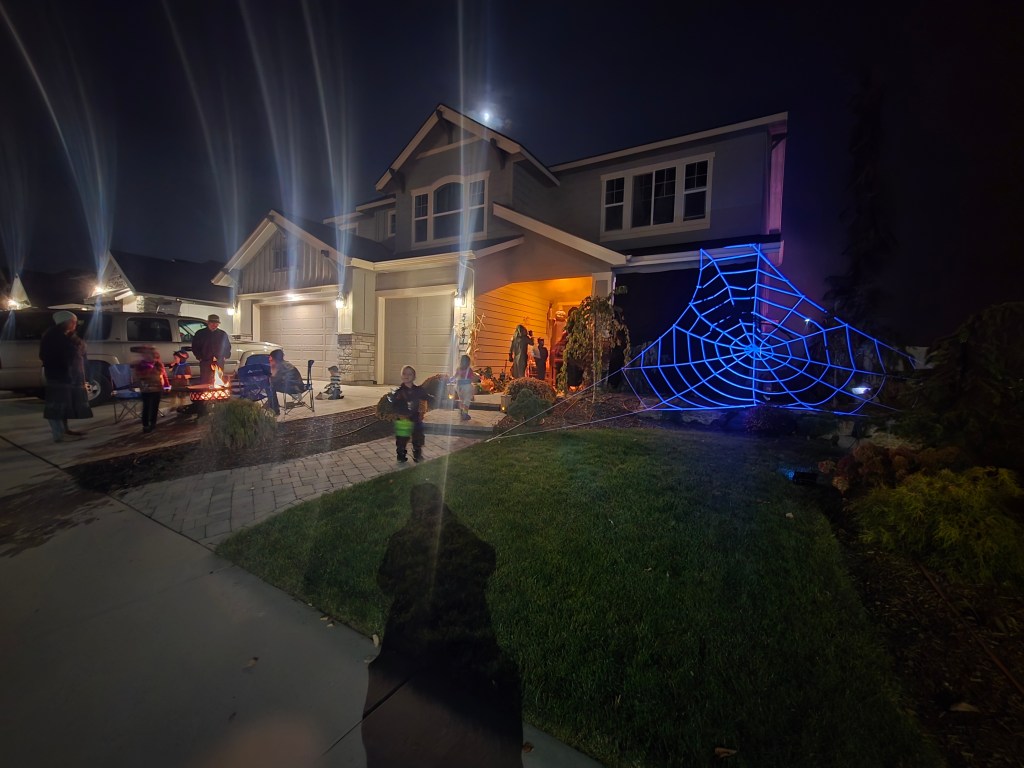
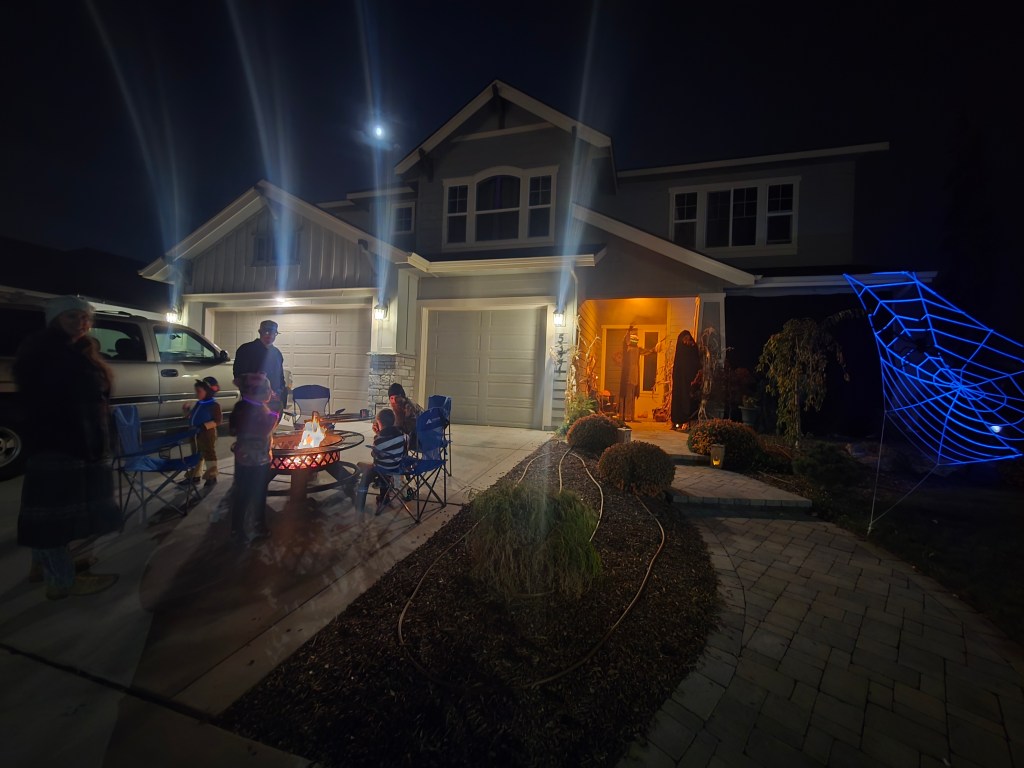
This Halloween, instead of the usual trick-or-treating, my brothers and I decided to make a little haunted house. We did something similar the year before, but it was crude and not exactly scary. This one wasn’t much of a ‘haunted house’ either, just a little room with a small scare pulled off by my brothers Hank and Jack, as well as a church friend, Andrew.

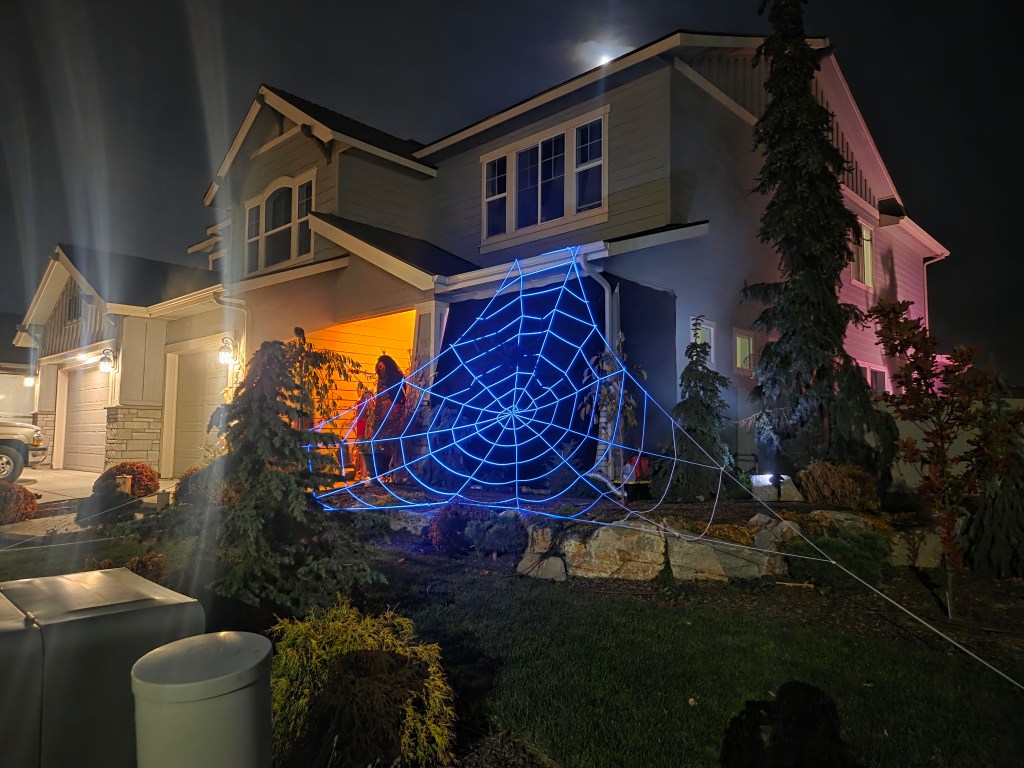
The house, which we didn’t bother to give a name, was pretty much two tarps strung up between the posts of our front porch, held aloft by little eye-rings and stuck to the walls and pillars with some tape and wood clamps. Inside, we strung up some fake cobwebs around the roof and walls, and my brother cut out a silhouette of Oogie Boogie from Tim Burton’s The Nightmare Before Christmas to put in an exposed window. I 3D printed purple and orange light covers to be used on the lights inside and outside the haunted house, respectively. The only major focal point of the haunted house was a small table with the candy bowl, flanked by Hank and Andrew, both in costume.

Outside the haunted house, a spiderweb was draped from the roof of the porch across the lawn, with a large UV light shining at it. On the back end of the haunted house itself, we had a little fog machine setup, consisting of the fog machine, a cooling chamber (cold fog stays on the ground) made out of a storage bin, and some dryer vent tubes to funnel the fog into the house.

When the trick-or-treaters came around on Halloween night, my brother, Jack, dressed in stilts and a pumpkin mask with a black cloak draped around him, would give the kids an initial scare. Expecting that to be the first and the last scare, they would continue into the fort where Hank and Andrew, both also swathed in black, would pretend to be statues. And when the kids reached for candy, they got spooked.

I didn’t take part in the haunted house because part of my costume was missing, and I decided to let Andrew and Hank take the rest of its parts so they could be inside the house, since I’d had the chance to do the scaring last year.

The Bacteriophage

The Bacteriophage are nuts. They are the single deadliest creature on the planet, killing millions every day. Why hasn’t the world been wiped out yet? Simple: Phages are microscopic.

Phages only kill cells, which can reproduce much quicker than they can be eaten. Phages make up more of Earth’s lifeforms than every other creature combined, including bacteria. The way a Phage kills things is simple: a Phage finds a cell, jabs it with a sort of fleshy needle located between it’s 6 legs, then injects its genetic code. The cell is kind of brainwashed and is forced to create more Phages, and then those Phages release an enzyme that causes the cell to burst open. The Phages inside are then released, and the cycle continues. Phages are incredibly accurate hunters, seeking only a single cell and some close family. There are more than one kind of Phage, so all kinds of cells are hunted.

Phages also provide potential medical uses to deal with Superbugs (antibiotic resistant bacteria and viruses). As bacteria become more antibiotic resistant, they have to give up Phage resistance. So using Phages and antibiotics at the same time could kill any kind a bacteria, no matter how resilient. It seems like a wonderful idea, but medical companies are skeptical, since we don’t have any proper testing to prove it would work without side effects. This means it probably won’t be used on any scale bigger than trialing for a long time.

| Medieval Weaponry, Part Three |

Boats! Rafts! Jet skis! Fun things that float on water and make huge waves to get your friends wet. But boats weren’t always fun, comfy things with which to goof off or have a luxurious cruise. Boats used to be used to transport slaves, soldiers, and the like. Only the elite, ruling class could afford to have any comforts along the journey. Boats have history, so lets look into it!

Boats were invented in Mesopotamia, as a way of crossing the two rivers on the nation’s sides. Early boats were rudimentary and crude, and they kind of sucked. They were slow, heavy, and very bad at staying afloat. Later on, people came up with sailboats, so one could relax and ride the wind instead of rowing for hours on end. But, as a lot of people know, wind changes. If an inexperienced sailor took to the seas without an oar, trusting fully in the wind, and then the wind stopped, what was he supposed to do? So they came up with monoremes, bigger boats with sails that could be raised or lowered, (to reduce drag if the wind was blowing at the ships bow) and a single layer of rowers under the deck. Then they realized that the monoremes were pretty good at their job. So they put two rows of rowers (a bireme), then three (a trireme), and used slaves to row. It was at this time that boats became almost entirely commonplace, with ports being built in Rome, Greece, Egypt, Israel, and anywhere else with power enough to warrant supplies.

Boats were also used in battle. A big, flat, open deck on a boat could accommodate some kind of siege weapon to be built, and voilé, battleships were born, using primitive cannons to engage battle at sea. Eventually, more modern warships came around, like the wooden-clads and iron-clads used in the Civil War, and even cotton-clad ships in the South. (They literally stuck a bunch of cotton onto the side of a ship. Unsurprisingly, it sucked. If you shot just one flaming cannonball or arrow, the ship would go up in flames instantly.)

After that, World Wars One and Two came around and there are all sorts of stories about battleships and their incredible achievements, but this essay is already too big, so I won’t go into those.

| Medieval Weapons, Part Two |

Time to talk about siege warfare! This includes, but is not limited to: Battering rams, trebuchet, catapults, and ballista.

Siege weapons are big. Some are stationary, others mobile. Some are cheap, some are expensive. At any rate, they all share a similar purpose: Assaulting castles/forts. The very first siege weapons were literally roofs on wheels. They were designed to give light soldiers cover from archers, allowing them to get close to castle walls and scale them with ladders. Later on came battering rams, structures of wood the size of an apartment, with a tree log suspended by ropes in the center. Soldier would wheel the vehicle to the castle doors, then push the log back, before letting it go. This allowed soldiers to utilize multi-ton tree trunks to break down castle doors.

In later times, people invented the catapult, a rudimentary machine that could fling small boulders hundreds of feet. Also, there were ballista, basically huge crossbows that fired spears. These were more for infantry combat then actually taking down walls, but they’re still pretty cool.

A more advanced catapult-type weapon, the trebuchet, could throw larger boulders farther distances, and with a lot more force. Weapons like these took many men to operate, and if they failed it could be catastrophic, with logs and rocks flying all around just because one rope snapped. They were also fairly easy to disarm, because the loss of one man could stop the entire firing process.

And of course we can’t forget the cannon. These were smaller, cheaper, easier to build, and could outdo a trebuchet’s power tenfold. Cannons were constructed of a large iron cylinder, filled with gunpowder and a large iron sphere, sometimes as big as 20 inches in diameter! Weapons like these made catapults and trebuchets obsolete, although they might still be used in case of an iron shortage.

Next week I will go over the evolution of ships, from wooden ones to iron ones, even cotton-clad ships used by the South in the American Civil War.

| Medieval Weaponry, Part One |

It’s official, I’ve run out of Black Hole stuff to blabber about, so today, I’m going to blabber about something entirely different: medieval weaponry and its common misconceptions! And in part two, (there might even be a part three!) I will talk about siege weaponry and its misconceptions.

One of the biggest misconceptions about medieval warfare is that everyone had access to swords, armor, and bows, and armies were massive strategic marvels. No, that only became a thing towards the end of the Middle Ages, in specific, the High Middle Ages. In the Early Middle Ages, (5th to 11th centuries) most armies were peasant armies, armed with sharpened scythes and crude axes and sickles, with little to no armor or training. Their armies were scattered, unorganized, and usually attacked in wild, frenzied waves, losing hundreds, even thousands, of men in the process.

In the High Middle Ages, (11th to 13 centuries), things like swords, armor, and more advanced battle techniques became common place. Another misconception is that Knights had bows. Archery was a very specific trade that people trained their whole lives for. In fact, historians and archeologists can tell who were archers from the unnatural size of the longbow man’s arm, because it took something like 150 pounds to draw the “English” longbow (it was invented by the Welsh).

Longbows changed the world forever. Before their invention, Knights dominated the battlefield. Their armor was almost impenetrable by swords or axes, and a Knight’s horse could plow through infantry with unyielding power. But a longbow arrow could pierce a Knight’s (or his horse’s) armor with ease. Suddenly, a Knight, covered head to toe in heavy, expensive armor, riding a horse that took years to bring up, was nothing. He could be slain in an instant by a peasant he couldn’t even find, let alone get to.

Who knows, this might take more than two parts, but even so, I am determined to write about all the stuff from the Medieval weapons department. Next week, methinks I will talk about siege weapons like trebuchets, catapults, ballista, and other stuff, like flinging dead bodies over castle walls.

| Black Hole Stars |

Black Hole Stars are only theoretical objects, so take everything said here with a grain of Sodium Chloride. I will be referring to them as though they did exist though, to make things less complicated.

Black Hole Stars are also called Quasi-Stars. They are theorized to have been stars that formed in the very early universe, with matter being so dense they could grow incredibly large without any fusion-ignition blowing it away. They would grow so fast that their cores collapsed into Black Holes while they were still forming. The Black Hole would be fed by the massive star’s gravity pushing gas in, while the star was kept steady by the radiation-pressure produced by the Black Hole. This created a Black Hole that could grow for millions of years (supposedly), gaining enough mass to become Supermassive or Ultramassive. Then, the accretion disk would get too big and would shear the star in two. Although this wasn’t quite a supernova, it was a lot more violent than one, with the star getting gutted, ripped apart, and the remains getting ejected into space.

These stars were theorized by scientists to try and solve a question. That question refers to the massive size gap in Black Holes. They get bigger and bigger up to around 10 solar masses, then all the sudden they get to millions or billions of solar masses, with no real middle ground. This puzzled scientists, who came up with the Quasi-Star Theory to explain it.

Credit:

Quasi-Stellar Radio Sources

Last week I wrote about Black Hole scale and in it I mentioned Quasi-Stellar Radio Sources, or Quasars for short. Since I think Quasars are such an interesting topic, they will be the subject I write on this week.

Quasars were discovered in the late 1950’s, when astronomers found strange radio-wave emitting points in the sky. It seemed like they burned like stars, and yet they outshined galaxies. They also emitted radio waves, and so they were named Quasi-Stellar Radio Sources.

Quasars are nuts. They are Supermassive or Ultramassive Black Holes fed by the gas of their galaxy swirling in around them and shooting it into space at around the speed of light. (For context, that’s about 40 million miles per hour.) These gas jets shoot out into space, creating “radio-lobes” that can be light-years across. The gas closest to the Black Hole is heated up so much that it shines like the sun, only this is a trillion times more efficient at making light, meaning it can light up a galaxy for us to see, y’know, 600 million light years away. And that’s the closest one. The farthest Quasar we know of is 31.7 billion light years away. And we still see it. Pretty darn bright.

And Quasars have the power to kill a galaxy, more or less. By heating up the gas in the galaxy so much, it prevents star formation. Hot gas has pressure, so it pushes back against gravity, while cold gas doesn’t even try to resist, so it collapses into a star.

There is no Quasar in the Milky Way, and if there was, it would pretty much eliminate any sort of “night” as it would light up the galaxy with the luminosity of trillions of stars. We are expected to get a Quasar one day though. Scientists speculate that if the Milky Way collides with Andromeda in about 4.5 billion years, as is thought to be the case, we will end up with a Qausar, as Sagittarius A and M31 collide to create an even bigger Black Hole, Milkdromeda.

Credits:

Black Holes – Bonus Part

Since I wrote way too much about Black Holes, I didn’t have the space to write on their size in part three. So today I’m writing a bonus part, to go over the size of Black Holes.

The smallest Black Holes we know of may not even exist. They are called Primordial Black Holes. Scientists theorise that in the insane density of the very early universe, any pocket of mass just slightly denser than the next would collapse into a Black Hole. These Black Holes would be about the size of a proton, and yet they would weigh as much as whole mountains. Scientists speculate they may be the “Dark Matter” that holds together galaxies.

Next up are Stellar Black Holes. These we definitely know exist. They are usually only the size of a city, and yet they can weigh as much as the sun. There is an unnamed Black Hole throwing around the red giant star V723. V723 is 9.74 million miles in diameter, 21 times as large as the sun, and is about the sun’s weight. It’s currently forced to orbit a Black Hole 11 miles in diameter, that weighs three times the sun.

Next in line are Supermassive Black Holes. These Black Holes are nuts. Sagittarius A, the Black Hole at the center of our galaxy, is 4 million times heavier and 40 million times larger than the sun. These Black Holes are the seeds for Quasi-Stellar radio sources, but I’ll get into those in a different essay. Anyway, they are really, really big. In fact, the first Black Hole we got a picture of was M87, a Supermassive Black Hole at the center of the Messier 87 galaxy.

Then there are Ultramassive Black Holes. These giants are insane in their size and weight, said to be the largest single things in the universe. TON 618 is a Black Holes that is 66 billion times heavier, and is about 57,114,947,999,134,622 miles wider than the sun. For you math nerds, that’s 1.32 x 10^11 times larger than the sun. You could fit 11 solar systems end to end in its Event Horizon.

Not much else to say. I’ll go over Quasars next time, and Black Hole Stars after that. Until then, watch this.

Credits:

Black Holes – Part Three

In my last essay, I went over what a Neutron Star is, and how to use them in Black Hole creation. This time, I will ramble about what a Black Hole is. There are three main things on/in a Black Hole, technically only two, the Accretion Disk, the Event Horizon, and the Singularity.

The Accretion disk is formed by matter being sucked into the Black Hole, moving fast enough that friction heats it up, creating a glowing orange disk. The reason these disks seem to swirl around and above the Black Hole is because, like Neutron Stars, Black Holes are so dense that light bends around them, so you can see the front and back at the same time.

The Event Horizon is the actual black orb, and it is the part of the Black Hole with a finite mass. For context, the Sun weighs 1 solar mass, which is the equivalent to 1,000,000,000,000,000,000,000,000 US tons. That’s a lot, but the largest Black Hole we know of, TON 618, weighs an estimated 66 Billion solar masses. That is the equivalent of 10^36 US tons, or 2.9 billion billion billion tons.

The Singularity is the part of the Black Hole that puzzles scientists. It’s supposedly a point infinitely small, and yet infinitely dense. Obviously, this breaks pretty much every rule that scientists have come up with concerning the rules of mass and scale, and that’s why it’s so cool. A point so dense and strange, there are theories that if the Event Horizon was shed somehow, the naked Singularity would destroy everything we consider to be “reality”.

I planned on going over the sizes Black Holes can reach to, but this post is already too long, so I’ll have to make a part four next week.

Credits: