Black Holes – Part Two

Now, picking up where we left off, let’s talk about Neutron Stars. The second most dense and strange things in the universe, Neutron Stars are surpassed in their gravity and extremity only by Black Holes.

If you didn’t read part one, lemme break it down. Neutron Stars are the super compacted pure Iron cores of imploded giant stars. During the star’s last moments, it will crush it’s core from the size of a planet to the size of a city. Gravity fights the core to death, battling against stupendous amounts of heat and pressure produced by the shrinking Iron sphere. If gravity wins, the star collapses into a Black Hole, and if the core wins, a Neutron Star is born.

Neutron Stars are nuts, and that’s putting it lightly. Their surfaces reach almost 2 million degrees, and they have magnetic fields a quadrillion times as strong as Earth’s, earning them the name “Magnetars”. They also have so much gravity that light bends around them, so you can see both sides of it, and it’s so dense that atomic nuclei touch. (Y’know, atoms, the things that really don’t like being super close together? Well, they don’t have a choice in the bottom layers of the crust.)

Also, Neutron Stars are a bit more like planets than stars, with an atmosphere and crust, not just layers of plasma. Heading into the crust, we see that protons almost all merge into neutrons, and the atomic nuclei begin to touch, creating “Nuclear Pasta” as some scientists lovingly call it. The atoms become strands and sheets, massive atomic nuclei with thousands of protons and neutrons, and it is thought to be the densest material in the universe, almost indestructible and un-meltable. Since we can’t exactly look inside a Neutron Star, all these things are just theories. One of these theories is that the material in the core is so hot and condensed that protons and neutrons dissolve into an ocean of free quarks, called Quark-Gluon Plasma, or maybe atoms don’t dissolve and just become a really insane sphere of molten metal.Whatever the case, Neutron Stars are ridiculous, powerful, and beautiful.

Now, let’s make a Black Hole. Simple, just smash two Neutron Stars together. They will explode in a Kilonova, an explosion that rips out their guts and shoots them into space, creating most of the heavier elements in the universe like Gold, Platinum, and Uranium. Now we have a Black Hole, a monstrosity I will go over next week.

Credits:

Black Holes – Part One

This little series of essays will be me rambling about how Black Holes form, what they do, and the events that lead to their forming. In this part, I’m going to go over how a star collapses to form a Neutron Star, the second most dense and insane thing that we know of in the universe. I’ll go over what a Neutron Star is and does in part two, and then I’ll blabber about Black Holes in part three.

The first part of the process in Black Hole creation is making a star implode. But first, allow me to explain how a star works, for some context. The outer layers of plasma weigh septillions of tons, pulled inward by gravity. This crushes and heats the core to such an extent that the Hydrogen atoms in the core fuse into Helium atoms. This releases the kind of energy used in the Russian Tsar Bomba, except in the case of our sun, this is 1.83 million times that. Every second. This explosive pressure pushes back on the outer layers, creating a balance. Eventually, the Hydrogen will run out. In the case of our sun, it will grow and grow as it runs out of juice until the outer layers dissolve, leaving a White Dwarf star in its place.

When the Hydrogen runs out in bigger stars, something different happens. The balance tips for just a moment and gravity wins. The outer layers crush harder, and the core burns hotter and faster, fusing heavier and heavier elements, while the outer layers swell massively. In the core, Carbon fuses to Neon in centuries, Neon to Oxygen in a year, Oxygen to Silicon in months, and Silicon to Iron in a day. Then, the balance ends entirely. Iron has no energy to give, and the star collapses. The outer layers of plasma smash inward, compressing the core from the size of a planet to the size of a city in seconds. The outer layers then bounce off the iron core, creating what we call a supernova, the most powerful explosion we know of, when millions of billions of trillions of tons of plasma are ejected into space, creating enough light to outshine galaxies.

What is left after the explosion is a comparatively tiny ball. This is a Neutron Star, the second most extreme thing in the universe, behind only Black Holes. I’ll explain Neutron Stars next week.

Credits:

3d Printing

There are lots and lots of 3d printer brands. Some are well known, like Bambu Labs and Prusa, while others are less known, like Elegoo and Artillery. Some are expensive, others cheap, some are small, or, like the one at the University of Maine, are 20 feet long.

Let’s go over how they work. There are two main types: resin and FDM. Resin printers use UV light to cure resin to make a 3d model. FDM printers lay melted plastic out in layers. Here is a basic diagram of how a FDM printer works (found this picture on the internet) .

Nothing Kiosk - 3D Printing - Nothing Community

The nozzle heats up to around 390 degrees (Fahrenheit), hot enough to melt plastic “filament” wire, which it then lays down in layers to make things. The finished print won’t be as perfectly smooth as an injection molded part, but as a tradeoff a 3d printer can make you pretty much anything you want.

There are quite a few types of filament, such as PETG, PLA, ABS, ASA, TPU, PVA, and HIPS, and there are just as many slicing softwares, such as Prusa slicer, Orca slicer, Ultimaker Cura, and Anycubic slicer. And there are enough printer types to match both slicers and filament with Cartesians, where the bed moves up, or on the z axis, and the print head goes left to right (x axis) and forward and backwards (y axis).

There are bed slingers, where the print bed moves back and forth (y) and the arm goes up and down (z) and left to right (x). Delta printers have a circular platform that doesn’t move, and the print head is suspend from three arms that go in every direction. There are more, like resin printers, but I’m not going to go down that rabbit hole yet.

In the end, the only thing that matters when getting a 3d printer is what you need or want to make. Want to print big stuff? get the Prusa XL. Want great multicolor and wonderful quality? Get the Bambu Labs X1 Carbon. But don’t take any of my advice on buying one. Go on YouTube and look on TNL’s or CNC Kitchen’s channel, to see which 3d printer is right for you.

Nukes

Nukes are cool. Nukes are interesting. Nukes are also weapons of mass destruction. I like nukes a lot, so I’m going to explain how they work and what they do.

The way a nuke works is by using conventional chemical explosives like Nitroglycerin to compact a sphere of Uranium 238 or Plutonium 239, so it is much smaller than it originally was. This causes their unstable nuclei to split, releasing lots of energy in the form of gamma radiation. These gamma waves in turn hit more nuclei causing them to split as well, releasing more energy, and so forth. This starts up a chain reaction that, in layman’s terms, makes bomb go big boom. You might be asking: why don’t nuclear reactors just explode? See, in a nuclear reactor, the fission is controlled and the energy is released in a relatively slow manner in order to boil water. In a nuke, all of the energy comes out in a trillionth of a second.

Now, lets go over what a nuke with an unspecified amount of Plutonium 239 is capable of. In the first picosecond of the nuke detonating, the shell around the core vaporizes and a burning sphere about a mile in diameter instantly appears. Inside of it, everything disappears. Why? Very simple. The sphere is 5 times hotter than the core of the sun, so everything inside vaporizes instantly. Seconds after the initial blast comes the thermal pulse, a wave of heat in which everything that can burn, will burn. One second your looking at your phone, the next, your entire body is on fire. At this point, the mushroom cloud forms, pushing high into the sky. Now comes the deadliest part of a nuke: the shockwave. The initial blast’s fireball pushes out a massive burst of air before it dissipates, leaving a vacuum where air should be. The air around the vacuum wants to fill the space, so it rushes in to do just that. In this moment, two things happen: a wave of air rushes out, strong enough to flatten buildings, then the air gets sucked back in to fill the vacuum left by the explosion. When the air goes out and then back in, the result is this: the city gets flattened, and fires from the thermal pulse get way bigger, resulting in mass destruction. The shockwave is the final stage of the nuke.

Shortly after the shockwave comes the fallout: radioactive debris pushed high into the atmosphere by the mushroom cloud begin to fall back down on the survivors in the ruins. The fallout can either be black rain or ash, and everyone in contact with it will be irradiated.

In the end, thousands, maybe millions, will have died. Most of those who survive will be permanently scarred and will probably succumb to cancer or radiation poisoning in the weeks, months, or years to come.

3D Modeling

So a while ago, mom got me a course on Udemy for Blender. Blender, in case you didn’t know, is a free modeling and animating software.

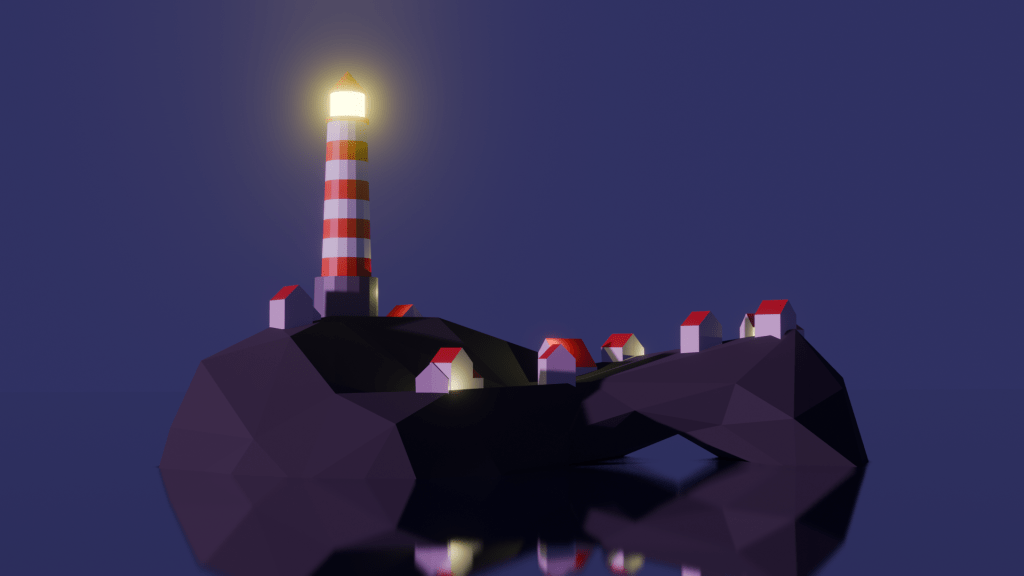
The teacher in the course is a British game developer named Grant Abbitt. So far, under his instruction, I’ve made a little lighthouse island and a low-poly T-rex with a mountain background. It’s a nice and slow course, and the skills I’ve learned have helped me make some cool stuff for myself and my brothers to 3d print. Here are pictures of the lighthouse island and the T-rex.

The Backyard

When we bought our house up here in Idaho, Mom told the builders to leave the backyard blank. That meant no grass, no trees, no bushes, and nothing else you may expect in a backyard’s layout. It was a blank slate, and mom wanted it that way so that we could build a “custom” backyard. Just know that whenever I say “we” in this post, I mean mom and dad, because me and my brothers kind of did… nothing. Mom and dad did pretty much all the work while we just sat there for most of the day. But, I gotta write this post about something, so I may as well list all the stuff mom and dad did, and just break it down.

First thing we did was pluck the weeds. The builders did little other than throw their empty water bottles and cigarette butts on the ground. Because they didn’t put grass and plants in, weeds were everywhere. So we went out there with a big bucket and plucked them all right out of the ground. Time went by, and we dug a big hole for a pond, and laid out a border for the patio. Then we Winter came, and we stayed inside for a while. When mom had us get out there in the Spring, we found out the pond hole had caved in during the winter, so we dug it back out, and the started tracing the hole for the trampoline. Then dad got some sand and a compactor, and so we filled in the outline for the patio with the sand and compacted it down into a flat, hard surface. Dad then proceeded to buy a truckload of bricks for our patio. After a lot of work on dad’s part, we had a brick patio. Then mom filled the backyard with woodchips. Mom said it would look better after a while, and I’m pretty sure this is a “trust the process” kind of thing. Why? Because I think the backyard looks hideous with woodchips. You don’t have to mow it, which is an upside, but it looks really, really bad. Anyway, we dug a big hole, put the trampoline in it, then mom put in some drip irrigation lines and some plants. We also planted some raspberries, except the package lied to us and we actually planted blackberries.

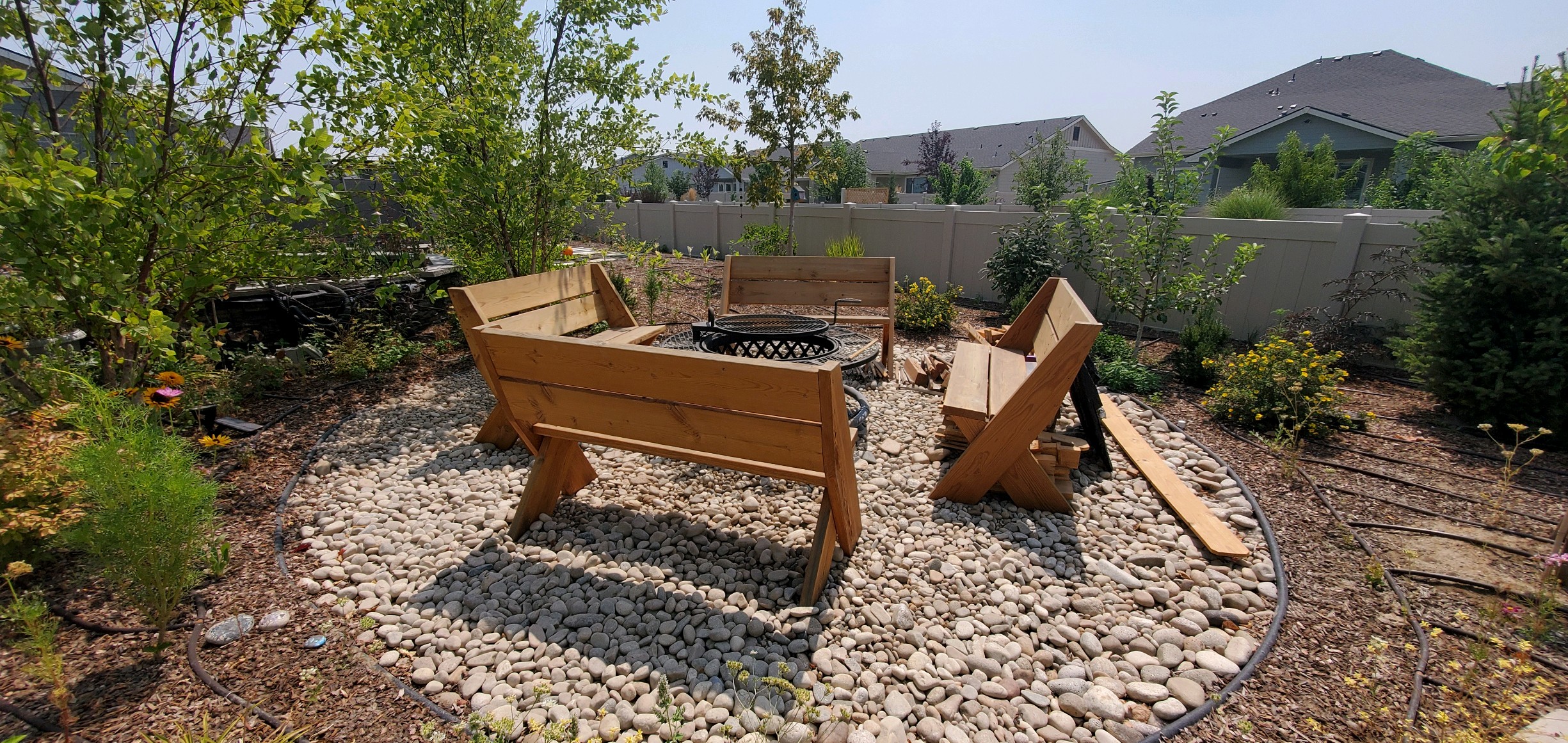
We did a lot of other stuff, but this essay is over 400 words long, so I gotta end it here. Here’s some pictures of our mostly finished yard.

Planter beds on the side yard. The tree to the right is a peach.
Inground trampoline.
Firepit.
Little planter thing at the corner window.
Big ‘ol fish pond.

Phobias

Phobias are immense and irrational fears that are caused by some traumatic thing that happened when you were a kid. That, or they’re more mild things that came with you from birth, like Entomophobia, the fear of bugs, or Nyctophobia, the fear of the dark.

My favorite phobia is Megolophobia. This is a fear, and sometimes even a slight wonder, of massive things and structures. Picture some huge structure in the distance, or a massive creature with it’s head above the clouds.

Anther cool Phobia is Hemophobia, the fear of blood. People with severe Hemophobia are terrified of blood, screaming and crying at any cut, simply because it drew blood.

There’s a lot of neat Phobias, including Heliophobia, the fear of sunlight (perfect excuse to be a gamer), Trypophobia, the fear of small, repetitive holes in things, and by far the funniest (that I know of), Hamburgerphobia. This is the legit fear of hamburgers. I’m not even making a joke. This is a real thing.